
Is Thurmond Actually Worth the Drive?
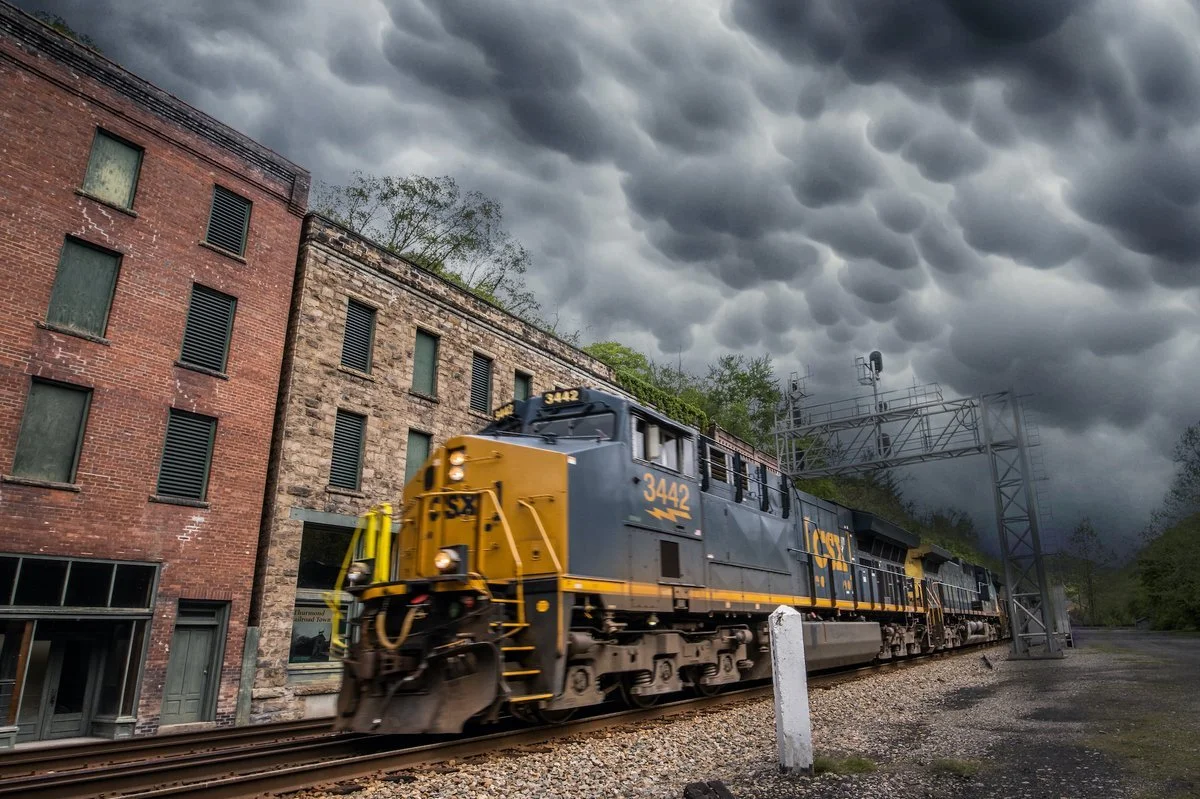
Coal train through Thurmond on a cloudy day. photo credit iron arch media
Yes. And we'd say that even if you only have one day in the gorge.
Thurmond is one of those places that's hard to explain before you've been there. It's a near-ghost town at the bottom of the gorge, accessible by a narrow winding road that some visitors don't bother with — which is exactly why you should. The drive alone is worth it. What you find at the bottom is something unlike anywhere else in the national park system.
What Is Thurmond?
Thurmond was once one of the most productive and rowdy railroad towns in America. At its peak in the 1920s, the town had a population of around 500 people — two banks, two hotels, a movie theater, restaurants, clothing stores, a jewelry store, and more. Its banks were among the richest in West Virginia. And the freight moving through Thurmond? At its height, the town handled more freight than Cincinnati and Richmond combined. This was not a backwater. This was the engine of an industry.
The town's "main street" was the railroad tracks themselves — the C&O Railway line that ran right through the center of everything. Until 1921, the only way in or out of Thurmond was by train. When you walk along the tracks today and feel like you're on a main street, that's because you are. That's exactly what it was.
The decline came in waves — the Great Depression, fires that took out the hotels and businesses, diesel locomotives replacing steam and making Thurmond's rail yard obsolete, and coal eventually running out. By the 1950s it was largely empty. By 1980 the population had dropped to 67. Today, per the 2020 census, five people call Thurmond home — making it the least-populous incorporated municipality in West Virginia. The town still has a mayor and a town council. They still meet, still pass ordinances, still make decisions about the future of a town with almost no one left in it.
Almost Ghost Town
There's a documentary in production right now called Almost Ghost Town, made by West Virginia filmmaker Jillian Howell. It follows the remaining four residents as they face not just the quiet decline of the town but an active demolition timeline — the National Park Service has slated several buildings for removal in late 2026 or early 2027. The film is a story about preservation, identity, and what it means to hold onto a place.
We mention this because it adds some urgency to a visit. Some of what you see in Thurmond right now may not be there in a few years. If you've been putting it off, this is a good reason to go soon.
And if you've ever dreamed of living somewhere genuinely unlike anywhere else in America — the remaining residents would love some neighbors. The town would welcome you.
The Drive Down
Take US-19 to the Glen Jean exit north of Beckley and follow the signs to Thurmond, about seven miles down WV Route 25. The road is narrow, winding, and steep in places — beautiful and a little nerve-wracking if you're not used to mountain driving. It is not suitable for RVs, trailers, or large vehicles. Don't try it in one of those.
Once you reach the bottom, you can actually drive a one-way loop through the town itself. It's narrow and steep and takes you past the houses where people actually live — a reminder that this isn't a museum recreation but a real place, hanging on. It's a slow and quiet drive that gives you a completely different perspective than the walking tour along the tracks.
What to See

Shot under moving train car, two kids sit on a raised sidewalk in Thurmond. photo credit iron arch media
The Thurmond Depot is the place to start. Built in 1904, restored by the NPS to its 1910s appearance, it now serves as a seasonal visitor center open from Memorial Day through Labor Day. Pick up a walking tour map here, learn about the history, and get your NPS passport stamp. And yes — it's still an active Amtrak stop. The Cardinal line pulls through three times a week on the same tracks that once carried thousands of passengers a day.
The commercial district along the tracks is the heart of the experience. The facades of the old banks, hotels, and businesses still stand, and peering into the windows and reading the history plaques gives you a real sense of how full this place once was. One pastor reportedly said the only difference between Hell and Thurmond was that a river runs through Thurmond. The poker game at the Dun Glen Hotel — held just outside town limits where alcohol was banned — reportedly ran continuously for 14 years.
Nearby trails make Thurmond a natural hub for a half-day or full-day adventure. The Rend Trail trailhead is on Route 25 on the way down to Thurmond — keep an eye out for it on the drive in. It follows the old railroad corridor with multiple trestles and the famous house-sized sandstone boulder that bent and then broke the train tracks underneath it. Stone Cliff Trail starts a couple of miles upriver and runs along the New River to a stand of old-growth forest. Both are quiet and almost always empty.
It's also worth knowing that Thurmond is one of several former coal towns in the New River Gorge — Kaymoor, Nuttallburg, and others are out there if you want to explore the broader history. But Thurmond is the only one where it genuinely feels easy to picture what life was actually like. The others have far less remaining — foundations, ruins, scattered remnants. Thurmond still has its buildings standing along the tracks, the depot restored, the facades intact. It's the only one that lets your imagination fully run.
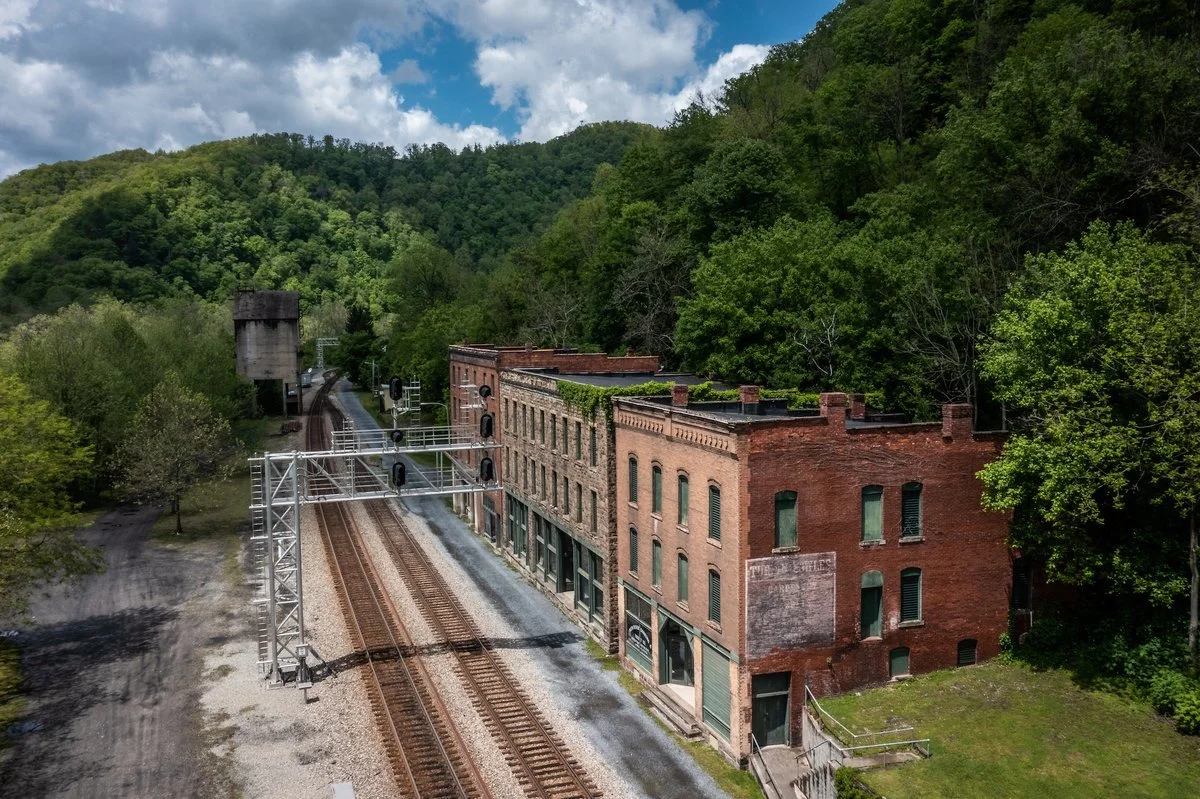
Aerial shot of the remaining thoroughfare in Thurmond. photo credit iron arch media
Practical Notes
Bring water and snacks — there is nothing to buy in Thurmond
The visitor center is seasonal (Memorial Day through Labor Day); the town is accessible year-round
Cell service is limited; download maps before you go
The road is not suitable for RVs or trailers
Allow at least two hours if you want to walk the district, do the one-way loop, and still have time to stop at the Rend Trail on your way back out
The Short Answer
Thurmond is not a polished attraction. There's no gift shop, no restaurant, no interpretive center with a gift shop and a film. It's a real town at the bottom of a gorge, slowly being reclaimed by time, still technically alive, still holding on. That's exactly what makes it worth the drive. It doesn't feel like anywhere else in the national park system because it isn't — it's a place where history didn't end cleanly, and where the story is still being written by the few people stubborn enough to stay.
Go soon. Some of what's there won't be there forever.